
A Deputy Made My 71-Year-Old Mother Stand in 91-Degree Heat for 40 Minutes Then She Asked Him to Say Her Name Over the Radio
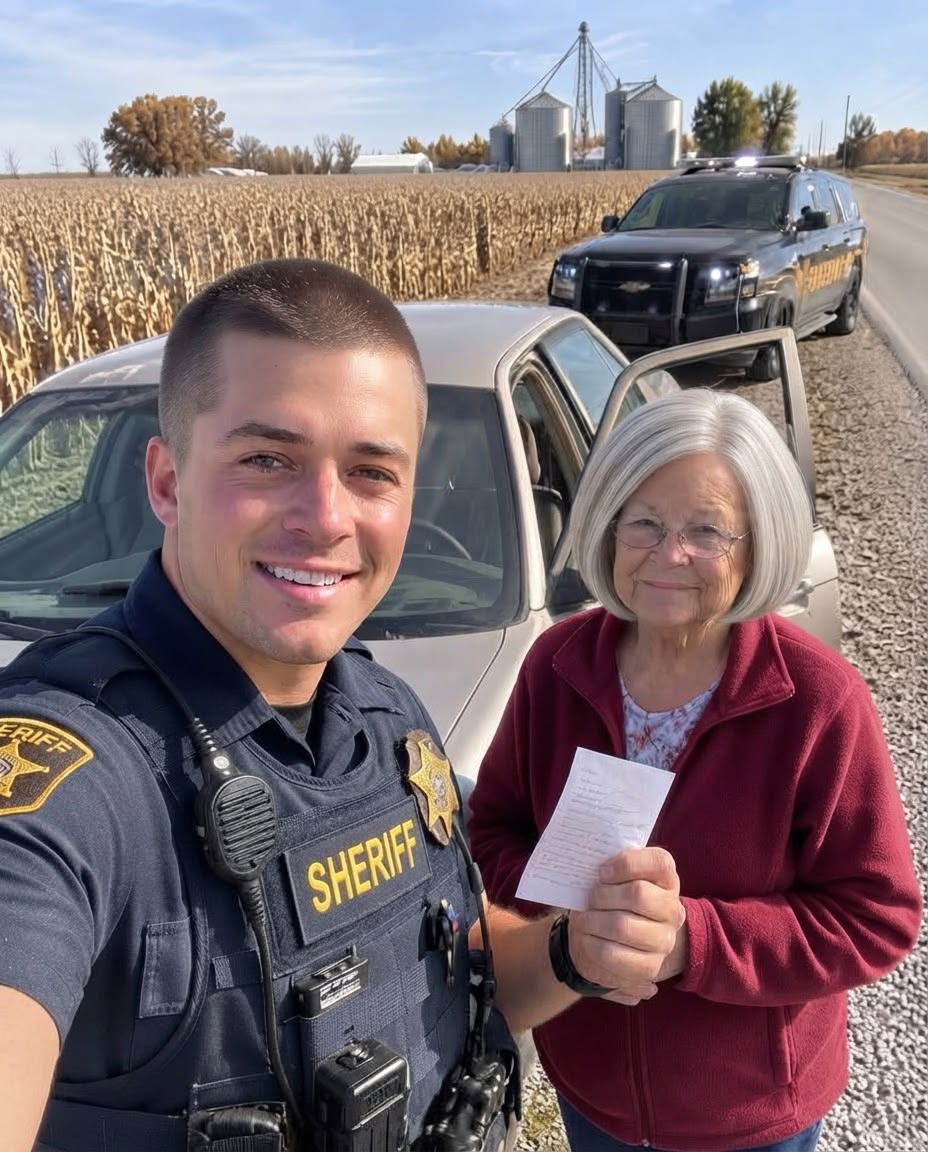

A young sheriff’s deputy pulled over my 71-year-old mother on County Road 6 and forced her to stand beside her car for forty minutes under the brutal August sun. It was ninety-one degrees, and there wasn’t a tree or building anywhere nearby to offer her shade.
When he inspected her temporary driver’s license, he smirked and accused her of printing it herself.
My mother didn’t lose her temper.
She didn’t threaten him, argue, or ask to be treated differently.
Instead, she calmly made a strange request.
“Deputy, would you mind saying my name over your radio?”
He looked at her as though she’d lost her mind.
But when he finally pressed the microphone and announced, “Shirley Hagen,” the response from dispatch changed everything.
And the smug expression he’d worn all afternoon was about to vanish.
***
The August heat was almost unbearable that afternoon.
The temperature had climbed to ninety-one degrees, and shimmering waves of heat rose from the asphalt along County Road 6.
Endless cornfields bordered both sides of the narrow highway, their green leaves barely moving in the heavy summer air.
There was no shade.
No roadside shelter.
Nothing but open farmland stretching toward the horizon.
I was riding in the passenger seat of my mother’s old Buick, holding a tray of homemade lemon bars on my lap.
We were heading to an afternoon gathering at church.
Mom insisted on driving.
At seventy-one, Shirley Hagen was probably the most careful person I’d ever seen behind a steering wheel.
She never rushed.
She always checked her mirrors.
And whenever a road sign said fifty-five miles per hour, she rarely went faster than forty-eight.
That’s why I couldn’t understand it when flashing police lights suddenly appeared behind us.
Mom immediately signaled and pulled onto the gravel shoulder.
A young deputy climbed out of his patrol car and walked toward her window.
Dark sunglasses concealed his eyes, and his rigid posture suggested he wasn’t interested in conversation.
“Driver’s license and proof of insurance.”
He didn’t introduce himself.
He didn’t explain why he’d stopped us.
Mom reached into her purse and handed over both documents without hesitation.
Her driver’s license had recently expired, but she’d already completed the renewal process at the county courthouse.
The replacement card hadn’t arrived in the mail yet, so the courthouse had provided a yellow temporary license.
The deputy examined the paper.
His eyebrows lifted.
Then he laughed.
“What’s this supposed to be? Something you printed at the public library?”
Mom answered gently.
“No, sir. That’s the temporary license the courthouse gave me. I’m still waiting for my permanent card.”
He turned the document over and inspected it again.
Then his voice hardened.
“Get out of the car, ma’am.”
My mother didn’t protest.
She carefully opened her door and stepped onto the gravel in her flower-patterned Sunday dress, her handbag resting against her elbow.
The deputy motioned toward the back bumper.
“Stand over there. Keep yourself where I can see you.”
I immediately leaned across the center console.
“Excuse me, Officer. She’s seventy-one years old.”
He bent toward the open window.
“You need to stay in the vehicle, sir.”
I opened my mouth to object.
But Mom looked back at me.
“Jeffrey. Stay seated.”
It was the same steady, unmistakable tone she’d used throughout my childhood whenever she expected me to listen.
So I obeyed.
The deputy returned to his patrol car, climbed behind the wheel, and shut the door.
His engine remained running.
From where I sat, I could tell he had the air conditioner blasting.
My mother, meanwhile, stood alone in the sun.
Five minutes went by.
Then ten.
Then twenty.
I watched her through the side mirror as she occasionally adjusted her stance on the uneven gravel.
The sunlight beat directly against her shoulders.
There wasn’t a single tree along that stretch of road.
Even the Buick’s exterior had grown too hot to touch comfortably.
She couldn’t lean against the car.
She had no chair.
And the deputy seemed perfectly content to remain inside his cooled patrol vehicle.
I looked down at the lemon bars on my lap.
The powdered sugar had started dissolving into the warm surface.
Even with the Buick’s air conditioning running, I could feel the oppressive heat through the windshield.
Mom had been standing outside in it the entire time.
After almost half an hour, she finally called toward the patrol car.
“Deputy, would it be all right if I sat inside my vehicle while you finish?”
His window lowered halfway.
“You’ll sit when I give you permission, ma’am.”
Then the glass slid back up.
I gripped the edge of my seat.
Every instinct told me to get out and confront him.
But my mother glanced toward me and offered a faint smile.
She wasn’t frightened.
She wasn’t trying to provoke anyone.
She simply wanted the encounter to end peacefully.
And because she had specifically told me to remain inside, I stayed where I was.
Looking back, that afternoon revealed something about my mother that I should have understood decades earlier.
For thirty-four years, Shirley Hagen had worked overnight shifts in the basement of our county courthouse.
Whenever someone asked about her career, I usually shrugged and said,
“She answers phones for the county.”
That was how I described more than three decades of her life.
Answering phones.
I knew she left home when most people were preparing for bed.
I knew she had missed dinners, holidays, and countless evenings because of her schedule.
But I had never taken much interest in what she actually did while she was there.
To me, she was simply Mom.
The woman who baked for church fundraisers.
Who kept extra napkins in her purse.
Who reminded me to take an umbrella even when the forecast promised sunshine.
Who drove cautiously and never wanted to inconvenience anyone.
And as I watched her standing under that punishing sun, I suspected the deputy had made the same assumptions.
He saw an elderly woman.
A yellow piece of paper.
And someone he could dismiss without consequences.
When forty minutes had passed, his patrol car door finally swung open.
He walked toward us carrying a ticket book.
Mom lifted her head as he approached.
“Well, ma’am, looks like you’re getting a few citations today.”
He glanced at the Buick.
“And I’m arranging to have this vehicle towed.”
I stared at him in disbelief.
My mother hadn’t been speeding.
Her documentation was legitimate.
And he’d just kept a seventy-one-year-old woman standing in ninety-one-degree heat for forty minutes.
I was ready to get out, regardless of what she’d told me.
But then Mom spoke.
“Deputy, could I trouble you with one little request?”
His pen stopped moving.
“What now?”
“Would you say my name over your police radio?”
He blinked.
“Excuse me?”
“My name. I’d appreciate it if you’d announce it to dispatch.”
“Why would I do that?”
“Just tell them Shirley Hagen is here.”
He looked at her for a long moment.
Then he turned toward the Buick, apparently hoping I’d share his amusement.
A mocking grin spread across his face.
“What, you think you’re some kind of celebrity in this county?”
Mom shook her head.
“Of course not, Deputy.”
I sank farther into my seat.
I couldn’t understand what she was doing.
After so much time outside in the heat, I briefly wondered whether she was becoming confused.
But when I studied her face, I saw nothing except composure.
Her hands rested neatly against her handbag.
Her breathing seemed steady.
And her eyes remained fixed on the deputy.
Finally, he sighed.
“Fine. Whatever makes you happy.”
He reached for the microphone clipped to his shoulder.
Pressed the transmission button.
And began speaking.
“Dispatch, Unit Fourteen here. I’ve stopped an elderly female on County Road 6. She’s carrying a temporary driver’s license that looks like somebody made it on a home printer.”
He let out a short laugh.
“Apparently, she wants me to announce her name over the air.”
He paused, enjoying himself.
“Her name is Shirley Hagen.”
He released the button.
Nothing happened.
Several seconds passed without a response.
The deputy checked his radio.
Then he looked at Mom again.
The afternoon seemed strangely quiet.
A blackbird landed on a nearby fence.
Dry leaves rustled among the corn stalks.
Farther down the road, heat shimmered above the empty pavement.
My mother didn’t move.
She didn’t smile triumphantly.
She didn’t appear worried.
She simply waited.
Then the radio suddenly crackled.
A female dispatcher’s voice came through the speaker.
But something about her tone was different.
She sounded startled.
Almost unwilling to believe what she’d just heard.
“Unit Fourteen… please confirm that name.”
The deputy frowned.
He rolled his eyes and reached toward his microphone again.
But before his fingers touched the button, Mom leaned forward slightly.
And I noticed an expression on her face that I had never seen before.
It wasn’t fear.
It wasn’t anger.
It was quiet recognition.
As though she already knew exactly who was listening on the other end of that radio.
I sat frozen inside the Buick.
For the first time in my life, I began to suspect that the thirty-four years my mother had spent “answering phones” in the courthouse basement involved something far more significant than I’d ever imagined.
And suddenly, I realized that the deputy might have just made the biggest mistake of his career.
If your 71-year-old mother had ordered you to stay inside the car while an officer treated her this way, would you have respected her wishes—or gotten out to protect her?
Son yorumlar